Contents:
- Where the Tradition Comes From
- Anniversary Flowers vs. Anniversary Gifts: Clearing Up the Confusion
- Year-by-Year Flower Guide: Years 1 Through 15
- Year 1 — Carnations
- Year 2 — Cosmos
- Year 3 — Fuchsia (Sunflowers)
- Year 4 — Geraniums (Blue Flowers)
- Year 5 — Daisies
- Year 6 — Calla Lilies
- Year 7 — Freesia
- Year 8 — Clematis (Lilac)
- Year 9 — Bird of Paradise (Poppy)
- Year 10 — Daffodil
- Year 11 — Tulips
- Year 12 — Peony
- Year 13 — Chrysanthemum
- Year 14 — Orchid
- Year 15 — Rose
- Year-by-Year Flower Guide: Years 20 Through 60
- Year 20 — Aster
- Year 25 — Iris
- Year 30 — Lily
- Year 35 — Coral Flower (Marigold)
- Year 40 — Gladiolus
- Year 45 — Blue Iris (Bluebells)
- Year 50 — Yellow Roses or Violets
- Year 55 — Lily of the Valley
- Year 60 — White Roses (Diamond)
- The Sustainability Angle: Choosing Anniversary Flowers Responsibly
- A Real-Life Example: The Year-Twelve Realization
- How to Order Anniversary Flowers: Practical Guidance
- Order in Advance
- Specify the Occasion
- Consider the Recipient’s Environment
- Pair with the Material Tradition Thoughtfully
- Think About Presentation
- Expert Perspective: What Florists Actually Recommend
- Quick Reference: Anniversary Flowers at a Glance
- Frequently Asked Questions
- Is there an official, universally standardized list of anniversary flowers?
- What if the assigned flower for our anniversary year isn’t in season?
- Do anniversary flower traditions apply equally to same-sex couples and non-traditional marriages?
- Can I combine anniversary flowers with anniversary gifts, or does that feel like too much?
- How many flowers should be in an anniversary bouquet?
- The Gesture Is in the Specificity
There’s a widely repeated piece of advice that floats around every February and every anniversary season: just send red roses. Red roses say love, the thinking goes, and love is universal, so roses work for any occasion. It’s a romantic idea, but it’s also a shortcut — and for anniversaries specifically, it misses an entire tradition that is centuries old, surprisingly personal, and genuinely meaningful once you understand how it works.
The truth is that anniversary flowers follow a symbolic language that runs parallel to the more familiar gift categories — wood for year five, silver for year twenty-five, gold for year fifty. Each milestone year carries its own floral meaning, and matching the right bloom to the right year transforms a beautiful gesture into a deeply intentional one. This guide will walk you through that language year by year, explain where the tradition came from, flag the sustainability considerations that increasingly matter to modern couples, and clear up the persistent confusion between anniversary flowers and anniversary gifts.
By the end, you will know exactly which flower to choose whether you’re celebrating year one or year forty, and why that choice communicates something that a generic bouquet simply cannot.
Where the Tradition Comes From
The practice of assigning symbolic meaning to flowers — a discipline called floriography — peaked in the Victorian era, roughly the 1820s through the 1880s. During that period, a strict code of social conduct made direct declarations of feeling inappropriate, so flowers became a proxy. Entire dictionaries of floral meaning were published and sold. Receiving a yellow tulip meant hopeless love. Sending a sprig of rosemary meant remembrance. The color, the species, and even the way a bouquet was held all carried information.
What we now call anniversary flowers grew out of this tradition but layered onto it an older Germanic practice of marking marriage milestones with specific materials. Medieval German communities would celebrate a couple’s fifteenth anniversary by crowning the wife with a silver wreath — hence “silver anniversary.” The fiftieth earned a gold wreath. Over time, both traditions merged, and by the early twentieth century, American etiquette writers had codified a reasonably consistent list that paired each anniversary year with both a material symbol and a floral one.
The flower assignments were never as universally standardized as the material ones — you’ll find small variations between sources — but a clear consensus has emerged around the most commonly celebrated milestones, and a working framework exists for every year up to the diamond anniversary at sixty.
Anniversary Flowers vs. Anniversary Gifts: Clearing Up the Confusion
Before going year by year, it’s worth addressing a confusion that sends many shoppers down the wrong path. Anniversary flowers and anniversary gifts are two separate but complementary systems, and conflating them produces awkward results.
The gift system (sometimes called the modern or traditional anniversary list) assigns a material: paper at year one, cotton at year two, leather at year three, and so on up through diamond at sixty. These are gifts — objects made from or associated with the assigned material. The flower system assigns a bloom based on the symbolic resonance between the flower’s meaning and what that year of marriage represents emotionally and relationally.
Here’s the practical difference: if you’re buying a gift, you might look for a leather wallet or a cotton throw at year three. If you’re buying flowers, you choose the bloom assigned to year three — the fuchsia — because its meaning aligns with the themes of that milestone. You can, of course, do both: bring a bouquet of the anniversary year’s flower and a gift made from the anniversary year’s material. But if someone tells you “just get the anniversary gift flower,” they are almost certainly referring to the floral tradition, not a flower-shaped version of the material gift. Keep the two lists separate and you’ll avoid the awkward moment of trying to explain why you brought a bouquet of cotton stems.
Year-by-Year Flower Guide: Years 1 Through 15
Year 1 — Carnations
The first anniversary is represented by carnations. They are among the oldest cultivated flowers in the world, with a documented history going back more than 2,000 years, and their traditional meaning centers on deep love and fascination — both appropriate for a couple just completing their first year. Red carnations signal admiration; pink ones carry the meaning of a mother’s love and gratitude; white ones suggest pure affection. A mixed bouquet covering all three colors tells a layered emotional story rather than a single note.
From a sustainability standpoint, carnations are one of the more eco-conscious choices available. They have a longer vase life than almost any other cut flower — often two to three weeks with basic care — which means less waste and better value. Look for carnations grown domestically or certified by Rainforest Alliance or Fair Trade standards to ensure ethical sourcing.
Year 2 — Cosmos
Cosmos flowers — the delicate, daisy-like blooms with feathery foliage — represent harmony and order, which maps neatly onto what a second year of marriage is actually about: figuring out how two people function together as a unit. The name comes from the Greek for “ordered universe,” and that origin gives the flower a philosophical weight that belies its breezy appearance. Deep pink and magenta are the most traditional colors for a second anniversary cosmos arrangement.
Year 3 — Fuchsia (Sunflowers)
Year three uses fuchsia as its flower — not the color, but the plant genus Fuchsia, named for sixteenth-century German botanist Leonhart Fuchs. These pendulous, jewel-toned blooms carry meanings of confiding love and trust. Because fuchsia can be difficult to source as cut flowers outside specialist florists, sunflowers are a widely accepted alternative for year three. Sunflowers add meanings of adoration and loyalty, and their sheer exuberance suits the optimism a three-year partnership typically embodies.
Year 4 — Geraniums (Blue Flowers)
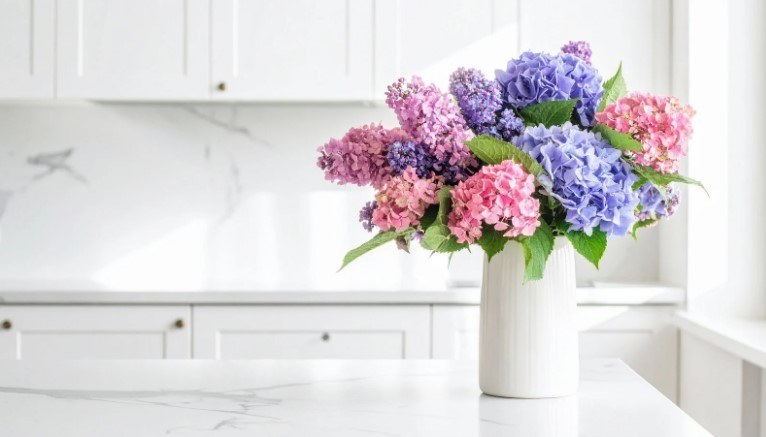
Geraniums have represented comfort and friendship throughout most of Western floriography, which connects well to year four’s themes of steady, companionable love. Blue flowers — hydrangeas, delphiniums, or agapanthus — are a popular contemporary alternative because blue is associated with depth and constancy. A year-four bouquet of deep blue hydrangeas surrounded by true geraniums makes an especially cohesive statement.
Year 5 — Daisies
The fifth anniversary is one of the most charming on the list. Daisies — especially the classic Shasta daisy or the more structured gerbera — carry meanings of innocence, loyal love, and new beginnings. Five years is a genuine milestone; it’s the point at which many couples say their relationship truly found its own identity rather than following a script. Daisies acknowledge that freshness. A wildflower-style bouquet mixing daisies with other meadow flowers captures the tone perfectly without spending a fortune.
Gerbera daisies in particular are worth highlighting for their eco profile. They are efficient to grow, require fewer pesticides than roses, and are now widely grown in greenhouses with closed water-loop systems. If environmental footprint matters to you, a gerbera-heavy fifth anniversary bouquet is an excellent choice.
Year 6 — Calla Lilies
Calla lilies bring elegance and regal beauty to year six. Their meaning in Victorian floriography was magnificent beauty, and their sculptural form — that single curving spathe around a central spadix — makes them one of the most architecturally striking flowers available. A clean white calla lily arrangement has a minimalist luxury that speaks to a relationship that no longer needs to prove itself with extravagance.
Year 7 — Freesia
Freesia is the flower for year seven, and its assigned meaning is trust and innocence, which resonates with the psychological reality that the seventh year is when many couples report feeling the deepest sense of security with each other. Freesia’s fragrance is another reason it’s an exceptional choice — it is among the most aromatic cut flowers available, which means it engages multiple senses and creates a stronger emotional memory. Choose freesia in cream, lavender, or pale yellow for a seventh-anniversary arrangement.
Year 8 — Clematis (Lilac)
Clematis, with its star-shaped blooms, represents mental beauty and ingenuity. Year eight is often the year couples have mastered the practical logistics of shared life and have space to appreciate each other intellectually and creatively. Lilac is a popular alternative — it carries meanings of first love’s emotions recalled with depth, and its color palette ranges from the palest lavender to rich purple. A mixed lilac arrangement with small white blooms creates a beautiful, fragrant gift.
Year 9 — Bird of Paradise (Poppy)
Bird of paradise is the assigned flower for year nine, and it carries a dramatic meaning: freedom, joy, and paradise itself. These orange and blue flowers are striking, architectural, and thoroughly unexpected — a good match for a relationship entering its ninth year with confidence. Poppies are a softer alternative, associated with eternal sleep and remembrance in some traditions, but also with imagination and luxury. For year nine specifically, bird of paradise is the stronger choice where available.
Year 10 — Daffodil
Ten years is a major milestone, and daffodils — bright, optimistic, and associated with new beginnings — are the traditional flower. The daffodil’s meaning combines chivalry and regard with the symbolic freshness of spring, which is appropriate for a couple beginning a second decade together. Yellow daffodils are the classic choice, but there are narcissus varieties with white petals and orange cups that make equally beautiful arrangements. Pair them with other spring bulb flowers — tulips, hyacinths — for a seasonal arrangement that celebrates the scale of the milestone.
Year 11 — Tulips
Tulips for year eleven carry meanings of perfect love and declaration. There are over 3,000 registered tulip varieties, which gives you an enormous range of expressive options. Red tulips declare love; purple tulips indicate royalty and admiration; white tulips claim worthiness or offer an apology; yellow tulips once signified hopeless love but have been rehabilitated in modern usage to mean cheerful affection. A multicolored arrangement reads as a celebration of complexity.
Year 12 — Peony
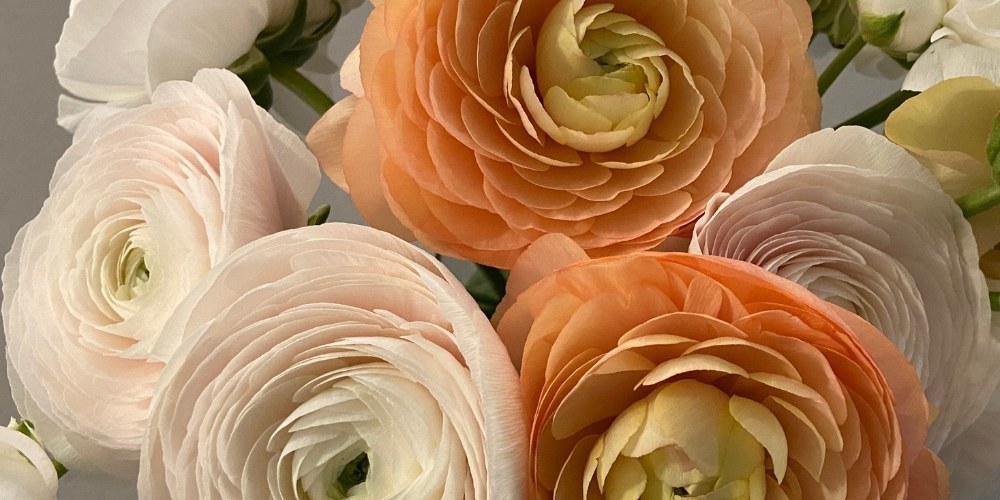
Here is a full disclosure worth making: mypeonika.com specializes in peonies, which are the assigned flower for the twelfth anniversary, and the connection is not coincidental. Peonies represent prosperity, good fortune, honor, and — above all — happy marriage. In Chinese culture, they are called the “king of flowers” and have symbolized good fortune and romance for over a thousand years. In the Victorian floral language, a peony indicated a bashful, bashfulness-turned-to-love that suits a couple who by year twelve has shed all pretense and settled into genuine intimacy.
For a twelfth anniversary, a lush peony arrangement in blush pink, coral, or deep rose makes a statement that is simultaneously opulent and emotionally precise. Peonies have a short natural season — late spring in most of the Northern Hemisphere — but year-round sourcing is available through specialty florists. When sourcing peonies, ask about country of origin: locally grown or domestic peonies have a significantly lower carbon footprint than those air-freighted from Ecuador or South America.
Year 13 — Chrysanthemum
Chrysanthemums carry meanings of fidelity and longevity throughout Asian floral traditions, and both meanings suit year thirteen. In Japan, the chrysanthemum is so culturally significant that it appears on the Imperial seal. Red chrysanthemums indicate love; yellow ones carry wishes for long life; white ones suggest honesty. Their durability as cut flowers — they routinely last two weeks in a vase — makes them an exceptionally practical choice in addition to a symbolic one.
Year 14 — Orchid
Orchids for year fourteen represent love, beauty, and strength. They have been objects of fascination and desire in Western culture since the Victorian orchid-hunting craze of the nineteenth century, when collectors paid enormous sums and risked tropical expeditions to acquire novel specimens. A Phalaenopsis orchid plant — the classic white or pink moth orchid — is especially appropriate because it keeps blooming for months with minimal care, making it a gift that outlasts any cut flower arrangement. From an environmental standpoint, a potted orchid is one of the most sustainable floral gifts: zero cut waste, long-lasting, and ultimately transplantable.
Year 15 — Rose
And here, finally, are the roses — but with context. Year fifteen is the anniversary that officially calls for roses, and the reason is that fifteen years of marriage represents a love that has truly proven itself: tested, matured, and still vibrant. The rose’s meaning at this stage is not the generic romantic gesture it represents on Valentine’s Day but something more specific — deep, enduring love that has survived real life. Deep red roses are traditional, but a mix of red, white, and pink tells a more complete story. Fifteen long-stemmed roses, one for each year, is a classic presentation that never fails.
Year-by-Year Flower Guide: Years 20 Through 60
Year 20 — Aster
Asters, with their star-shaped blooms and daisy-like appearance, carry meanings of patience, elegance, and love of variety — all themes resonant with two decades of shared life. Their name comes from the Greek word for “star,” which gives them a poetic additional layer of meaning: you are each other’s constants in a shifting sky. Purple asters are the traditional choice for a twentieth anniversary.
Year 25 — Iris
The silver anniversary calls for irises. In Greek mythology, Iris was the goddess of the rainbow and the messenger between the gods and humanity, which gives these flowers meanings of wisdom, hope, trust, and valued friendship — a nearly perfect summation of what twenty-five years of marriage produces. Purple iris is the classic choice, but blue iris has a more restrained elegance that suits the gravity of the silver milestone.
Year 30 — Lily
Lilies for year thirty represent devotion and purity, along with the majesty that three decades of partnership earns. Stargazer lilies — deep pink with speckled centers — have a dramatic, fragrant presence that suits a major milestone. White Casablanca lilies offer a cleaner, more formal elegance. For an eco-conscious approach, look for lilies grown under glass in the Netherlands or domestically; lily cultivation can be done with minimal pesticide use when managed carefully.
Year 35 — Coral Flower (Marigold)
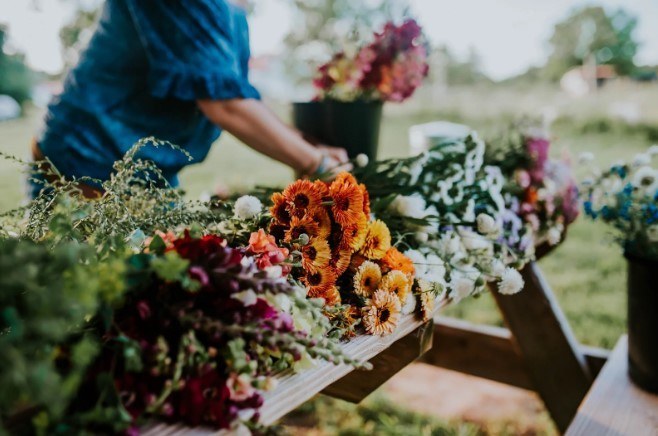
Year thirty-five uses coral flowers, and the most commonly cited bloom is the marigold in coral or orange tones. Marigolds carry meanings of creativity, passion, and the warmth of the sun. In many cultures — Day of the Dead traditions in Mexico, Diwali celebrations in India — marigolds represent the bright thread that connects the living to what they love most. For a thirty-fifth anniversary, a rich marigold arrangement brings both cultural depth and vibrant visual impact.
Year 40 — Gladiolus
Gladiolus flowers carry a meaning directly tied to their Latin origin: gladius, meaning sword, and the flower name means “sword lily.” The symbolic meaning that has attached to this etymology is strength of character, generosity, and never-giving-up love — meanings that fit forty years of marriage with remarkable precision. Gladioli are tall, dramatic, and available in a wide range of colors from white through pink to deep burgundy. They make an impressive visual statement suited to a truly major milestone.
Year 45 — Blue Iris (Bluebells)
For year forty-five, the blue iris appears again (distinguishing it from the purple iris of year twenty-five) or alternatively, bluebells — small nodding flowers associated with humility, gratitude, and everlasting love. Both choices carry a quiet depth appropriate for a milestone that few couples reach. A soft arrangement of blue and violet blooms with silver accent foliage honors both the floral tradition and the silver-to-gold continuum of milestone anniversaries.
Year 50 — Yellow Roses or Violets
The golden anniversary carries special weight, and its flowers reflect that. Yellow roses — which traditionally mean friendship, warmth, and caring — are the most common choice for the fiftieth, representing a love that has also become the deepest kind of friendship. Violets are the alternative, carrying meanings of faithfulness, modesty, and eternal devotion. A bouquet combining both yellow roses and deep purple violets creates a visual metaphor for the way romantic love and companionate friendship have woven together over fifty years.
Year 55 — Lily of the Valley
Lily of the valley carries one of the most layered meanings in the floral tradition: a return to happiness, purity, humility, and the sweetness of a love that has endured. Its nodding white bells and clean fragrance are timeless. The practical consideration is that lily of the valley has a short spring season, so sourcing it at other times of year requires advance planning with a specialty florist.
Year 60 — White Roses (Diamond)
The diamond anniversary, if reached, deserves the most pristine expression of the floral tradition. White roses at year sixty represent unity, virtue, and the kind of love that has been tested and clarified by time into something almost luminous. A pure white rose arrangement — perhaps in a crystal vase to echo the diamond theme — is both visually stunning and symbolically complete. White spray roses mixed with larger garden roses creates textural depth without introducing competing colors.
The Sustainability Angle: Choosing Anniversary Flowers Responsibly
The cut flower industry carries a significant environmental footprint that often goes unexamined at the point of purchase. Approximately 80 percent of cut flowers sold in the United States are imported, primarily from Colombia, Ecuador, and Kenya. Air freight is the primary mode of transport, and the carbon emissions associated with transporting fragile, perishable flowers by plane are substantial. In addition, large-scale flower farming in developing countries has historically relied on pesticides at levels that would not be permitted under U.S. regulations.
This doesn’t mean anniversary flowers are an environmental disaster — it means informed choices make a material difference. Here are the specific steps that matter:
- Choose certified flowers. Look for Rainforest Alliance, Fair Trade USA, or Florverde Sustainable Flowers certification on any imported blooms. These certifications audit both environmental practices and worker conditions.
- Buy domestic when possible. The American cut flower industry, while smaller than it was before the import era, still produces excellent peonies in the Pacific Northwest, sunflowers throughout the Midwest, and specialty blooms in California and Hawaii. Domestic flowers eliminate air freight entirely and support local agriculture.
- Prefer longer-lasting varieties. A chrysanthemum arrangement that lasts fourteen days has less impact per day of enjoyment than roses that last seven. Carnations, alstroemerias, and orchids are all strong on longevity.
- Consider potted plants. For anniversaries — especially milestone ones like year ten, twenty-five, or fifty — a potted flowering plant generates no cut-flower waste, lives on after the day, and can be planted outdoors in some climates.
- Compost spent flowers. Cut flowers are organic material. A home compost bin converts a spent bouquet into soil amendment rather than landfill waste.
When ordering online for delivery, working with a florist who sources thoughtfully matters. Look at sourcing pages, read about certifications, and don’t hesitate to ask. A good florist — including those offering a bouquet of flowers for anniversary — will be able to tell you where the primary flowers originated.
A Real-Life Example: The Year-Twelve Realization
A friend of mine — married twelve years and entirely committed to the practice of marking every anniversary with a meaningful gift — had been sending the same arrangement every year for a decade: red roses, wrapped in brown paper, delivered to his wife’s office. He was proud of the ritual. She received them gratefully every year.
It was only at their twelfth anniversary that a colleague of his mentioned the peony tradition. He had never heard of anniversary flowers as a system. He ordered a full lush arrangement of blush and coral peonies instead of the expected roses, added a note that explained the twelfth-anniversary meaning — prosperity, happy marriage, the “king of flowers” — and sent them to the office as usual.
His wife later told him it was the most thoughtful thing he had done in years. Not because peonies are more beautiful than roses (she loved the roses too), but because the specificity of the gesture — the research, the meaning, the fact that he knew what year they were on and matched something real to it — communicated a kind of attention that a generic bouquet, however beautiful, cannot replicate. That story has stuck with me because it illustrates exactly why this system exists and why it works.
How to Order Anniversary Flowers: Practical Guidance
Knowing which flower belongs to which year is only half the equation. Getting a beautiful, fresh, correctly assembled arrangement delivered on time requires a few practical considerations.
Order in Advance
For milestone anniversaries — year ten, twenty-five, fifty — and for flowers with limited seasonal availability (peonies, lily of the valley, freesia in certain colors), order at least one week in advance. Two weeks is better. Specialty florists book up around major holidays like Valentine’s Day and Mother’s Day, and those are the same periods when many spring anniversary flowers are most in demand.
Specify the Occasion
When ordering, tell the florist specifically which anniversary year you’re marking. A good florist will know the floral tradition and can guide you if your preferred flower is unavailable due to seasonality. They can suggest the closest meaningful alternative rather than defaulting to a generic arrangement.
Consider the Recipient’s Environment
If the flowers are being delivered to a workplace, an arrangement that travels well and doesn’t require immediate vase access works better than something architecturally complex. If they’re going to a home with pets, note that lilies (especially Asiatic and Easter lilies) are highly toxic to cats — an important consideration that overrides symbolic tradition.
Pair with the Material Tradition Thoughtfully
For milestone years, combining the anniversary flower with a small gift referencing the material tradition creates a complete gesture. A fifteenth anniversary might combine a bouquet of roses with a small piece of crystal (the traditional year-fifteen gift). A twenty-fifth might pair irises with a silver frame. The two traditions reinforce each other without competing.
Think About Presentation
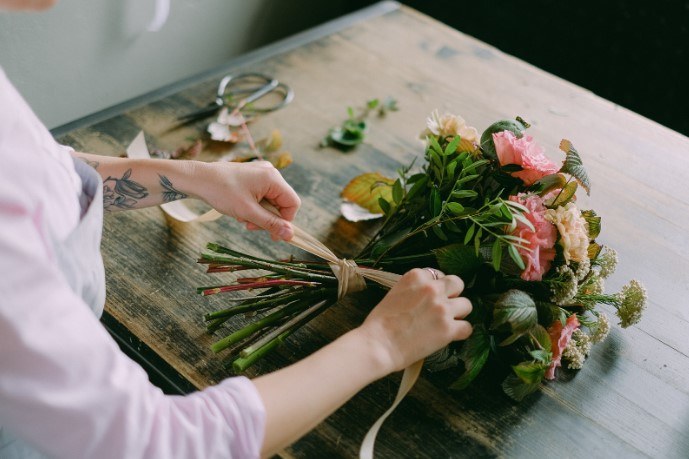
The same flowers presented differently read completely differently. A hand-tied bouquet wrapped in kraft paper and tied with ribbon feels intimate and personal. Flowers in a vase feel more formal. A low centerpiece arrangement suits a table celebration. Tell your florist how the flowers will be presented and received, and they can help shape the arrangement accordingly.
Expert Perspective: What Florists Actually Recommend
Professional florists who work with the anniversary tradition emphasize a few points consistently. First, the symbolism only works if you communicate it. Sending peonies for a twelfth anniversary without a note explaining the tradition means the recipient may simply see a beautiful bouquet — lovely, but lacking the layer of meaning that makes the gesture extraordinary. A brief handwritten note (or even a card insert) explaining “these are peonies for our twelfth anniversary — in the floral tradition they represent prosperity and happy marriage” transforms the flowers from a gift into a story.
Second, experienced florists note that color within the anniversary flower matters as much as species. Year-eleven tulips in a deep red read very differently than yellow tulips, and both read differently than a deliberately mixed palette. The species carries the primary meaning; the color adds nuance. Discuss both with your florist when ordering.
Third, florists who specialize in anniversary work recommend building a tradition over time. If you mark year one with carnations and year five with daisies and year twelve with peonies, the accumulation of those gestures builds a narrative. Some couples keep a small photograph of each year’s anniversary arrangement. Over a decade or two, that photo collection becomes a kind of visual love letter.
New baby flowers serve a completely different symbolic and emotional purpose from anniversary flowers — they’re available at https://mypeonika.com/collections/new-baby-flowers — and while some families do celebrate a baby’s arrival in the same month as a wedding anniversary, the two occasions call for entirely different arrangements. New baby flowers lean toward soft whites, pale yellows, and gentle pinks, with emphasis on delicacy and new beginnings. Anniversary flowers, by contrast, can carry rich colors, dramatic scale, and complex fragrance — they’re celebrating something that has matured and deepened rather than something newly arrived.
Quick Reference: Anniversary Flowers at a Glance
- Year 1: Carnation — deep love, fascination
- Year 2: Cosmos — harmony, order
- Year 3: Fuchsia / Sunflower — confiding love, adoration
- Year 4: Geranium / Blue Hydrangea — comfort, constancy
- Year 5: Daisy / Gerbera — loyal love, new beginnings
- Year 6: Calla Lily — magnificent beauty
- Year 7: Freesia — trust, innocence
- Year 8: Clematis / Lilac — mental beauty, first love recalled
- Year 9: Bird of Paradise — freedom, joy
- Year 10: Daffodil — new beginnings, chivalry
- Year 11: Tulip — perfect love, declaration
- Year 12: Peony — prosperity, happy marriage
- Year 13: Chrysanthemum — fidelity, longevity
- Year 14: Orchid — love, strength, beauty
- Year 15: Rose — enduring love, maturity
- Year 20: Aster — patience, elegance
- Year 25: Iris — wisdom, trust, friendship
- Year 30: Lily — devotion, majesty
- Year 35: Marigold — creativity, warmth
- Year 40: Gladiolus — strength, generosity
- Year 45: Blue Iris / Bluebell — gratitude, everlasting love
- Year 50: Yellow Rose / Violet — friendship, faithfulness
- Year 55: Lily of the Valley — return to happiness
- Year 60: White Rose — unity, virtue
Frequently Asked Questions
Is there an official, universally standardized list of anniversary flowers?
No. Unlike the material anniversary list, which was formalized by the American National Retail Jeweler Association in 1937 and has a fairly consistent modern version, the floral list was never centrally standardized. Different etiquette books, floral industry guides, and cultural traditions assign slightly different flowers to some years. The list in this guide reflects the most widely cited consensus across American and British sources, but you will find variations — particularly for the less commonly celebrated years like year eight or year thirty-five. When sources differ, both flowers are typically valid choices.
What if the assigned flower for our anniversary year isn’t in season?
Seasonality is a genuine constraint, and it’s one of the arguments for working with a specialty florist who sources globally. Many flowers are available year-round through greenhouse cultivation or international sourcing — peonies, roses, lilies, and orchids included. For truly seasonal flowers like lily of the valley (spring only in North America) or some freesia varieties, advance ordering allows florists to source from the Southern Hemisphere when the Northern Hemisphere is out of season. Alternatively, a skilled florist can suggest a flower that shares meaningful symbolic overlap with the traditional assignment.
Do anniversary flower traditions apply equally to same-sex couples and non-traditional marriages?
Completely. The floral tradition is based on the number of years of partnership, not on the genders of the people in the relationship. The meanings assigned to each year’s flower — trust, fidelity, prosperity, joy — are universal human values, not gendered ones. The tradition applies equally to any committed couple marking a milestone together.
Can I combine anniversary flowers with anniversary gifts, or does that feel like too much?
Combining them is entirely appropriate and actually more traditional than choosing one or the other. The two systems developed in parallel and were always intended as complementary. For major milestones — year twenty-five, year fifty — presenting both a material gift and a thoughtfully chosen floral arrangement creates a richer, more complete celebration. For smaller yearly anniversaries, the flowers alone may be the right gesture; the material gifts are often impractical at early years (who genuinely wants a cotton or paper gift?). Use your judgment based on your relationship’s own traditions.
How many flowers should be in an anniversary bouquet?
There is no fixed rule, but one charming tradition is to include one stem for each year of the marriage. Year five gets five gerbera daisies; year twelve gets twelve peonies; year twenty-five gets twenty-five irises. This approach naturally scales in impressiveness with the milestone, and it gives the florist a clear structural number to work with. For milestone years with large numbers — year forty, fifty — this can become expensive and unwieldy, in which case a beautifully proportioned arrangement without a specific count is entirely appropriate.
The Gesture Is in the Specificity
Red roses are beautiful. There is no argument against them as flowers. The argument this guide has been building is simply that for an anniversary — for a celebration of a specific number of years with a specific person — a specific flower chosen for its meaning and its relationship to that year’s milestone communicates something that a generic gesture cannot.
The floral tradition is not complicated. It asks only that you know what year you’re in and care enough to match the flower to the moment. That research, that specificity, that “I know we’re in year twelve and here is the flower that means what this yea